

Tendons do not behave like other tissues, and the two things people instinctively do for tendon pain, rest it and stretch it, are the two things most likely to keep it going. Tendons need load. The skill is in giving them the right amount, in the right order, for long enough.
Below is a guide to a loading protocol we use with many runners at Core Physio & Pilates, including the criteria for moving between stages, because the stage you are in matters far less than knowing when you have earned the next one.
Initial tendon pain is not tendinopathy. Tendinopathy refers to structural changes within the tendon that persist for longer than 6-12 weeks. Tendon changes progress through phases that warn the body that something isn’t right: starting with the initial reactive phase, then moving onto the attempted healing but disrepair phase, then onto a chronic tendinopathy. Chronic tendinopathy sounds scary, but what it means is you’ve had your tendon pain for longer than 3 months, contributing to structural wear and tear changes within the tendon, which requires targeted rehab and appropriate strengthening to heal.
The presentation of tendinopathy is distinctive enough that most people can recognise it:
In runners, it turns up most often in the Achilles, the patellar tendon just below the kneecap, and the gluteal tendons at the outside of the hip.
It is important to monitor your pain levels because this determines how soon you can progress to the next stage of a rehab protocol.
Rate your pain out of 10 during and after the exercise. A maximum of 4 to 5 out of 10 pain is acceptable, and expected. It should settle back to your baseline within 24 hours.
If it does not settle by the next day, the dose was too high, and you need to reduce your load.
Unless your injury is severe and/or you have been instructed otherwise by a health professional, discomfort within a reasonable range is part of the treatment, to enable the tendon to adapt sufficiently.
If any of the above sounds similar to the pain you are experiencing, then here are a few steps to follow to begin your rehab journey.
What you do: isometric holds, which involve a static contraction with no movement. For the Achilles, that is holding a calf raise at the top range. For the patellar tendon, a wall sit or a static knee extension hold. For gluteal tendons, an isometric hip abduction press.
Dosage: 30 to 45 seconds, repeated 5 times, once or twice a day.
These can immediately reduce your tendon pain.
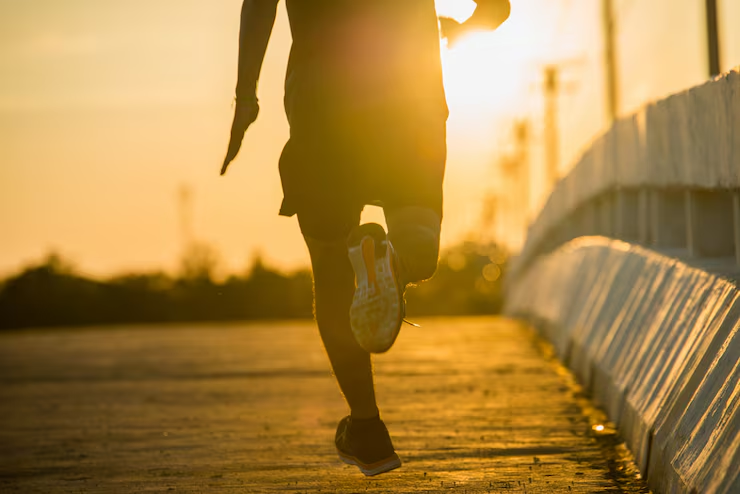
Running: reduce, but try not to stop, unless it’s too painful or if it’s impacting the rest of your daily function.
Move on when: morning stiffness has clearly reduced and you can complete your reduced runs within the 24-hour pain rule for a week.
Typically, this can take 1 to 2 weeks.
What you do: heavy, slow resistance work through range. Slow means about 3 seconds lowering and 3 seconds lifting, and heavy means genuinely heavy.
Dosage: you want to aim for 6 to 8 repetitions, where the last two are difficult. Building up to 3 to 4 sets, repeated 3 times a week. Over time, add weight as you are able to.
Type of exercise: for the Achilles, this can be calf raises off the edge of a step – perform with both a straight knee (to bias the gastrocnemius muscle) and a bent knee (to bias the soleus muscle). For the patellar tendon, this can be loaded squats and/or split squats through a controlled range. For the gluteal tendons, load up in hip abduction and/or single leg work.
Move on when: you can perform the loaded exercise with good control at a meaningful weight, symptoms have settled substantially day to day, and morning stiffness is minimal.
Typically, this can take 4 to 6 weeks. This is the longest stage and rushing it is the single most reliable way to end up back at stage one.
Heavy, slow work builds a strong tendon, but it does not build a springy one, and running is fundamentally an elastic activity. The tendon has to store energy on landing and return it on push off, at speed, thousands of times.
What you do: skipping, pogo hops, double leg then single leg hopping, bounding, and short accelerations. Start with a low volume, and only do these on days where you are not doing Stage Two heavy loading exercises (it is important to continue Stage Two alongside Stage Three).
Move on when: you can hop on the affected leg repeatedly without symptoms and the next-day response stays minimal.
Typically, this can take 2 to 4 weeks.
What you do: increase volume, then increase intensity, then add hills.
Change or add one variable at a time, whilst also monitoring your 24-hour symptoms each time.
Long-term, it is also important to continue your 2 sessions a week of heavy load / strength, alongside your runs.
Dosage: aim for 2 to 3 run sessions a week, altering speed, volume, and intensity to adapt your tendon to different loads.
Typically, this can take 4 or more weeks, and around 12 weeks all up for a well-established tendinopathy.
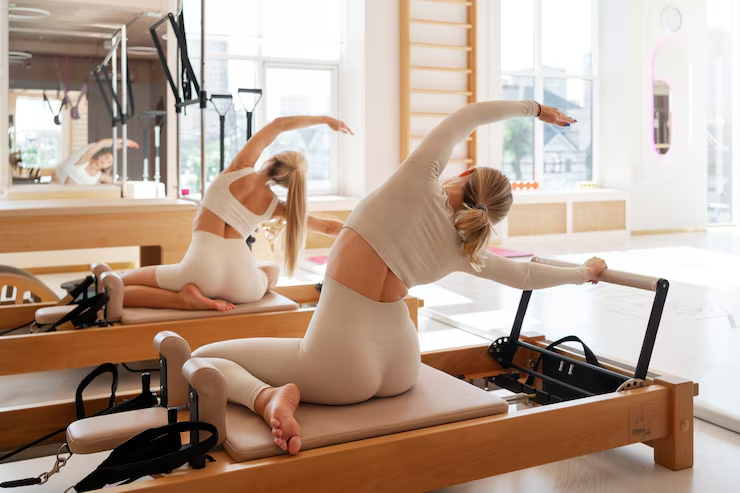
No matter what stage of injury or rehab you are in, it is important to work out what caused your tendon pain, so that it doesn’t continue to flare up. Additionally, this trigger is often associated with a strength deficit further up the chain, most often at the knee, hip, or trunk, thus performing strength and conditioning exercise alongside your runs, like Clinical Pilates for example, can significantly improve your running and reduce the risk of re-injury.
Don’t stretch the affected tendon, because this compresses it against the bone underneath which further aggravates symptoms. It is much more effective to load the tendon. Stretching or mobilising other areas is usually fine.
Rarely. Imaging findings correlate poorly with symptoms in tendons, and scans routinely show changes in people who have never had pain. The diagnosis is usually clear from history and examination.
Corticosteroid injections can reduce pain in the short term but have poorer long-term outcomes in tendons and may weaken the tissue. They are not first line, and if one is offered, make sure that there is a loading plan or management plan alongside it.
Yes, but keep it low impact. Cycling and swimming maintain fitness without overloading the tendon. Just be aware that cycling loads the patellar tendon and deep-water running loads the Achilles, so choose the type of activity based on which tendon is involved.
Tendons respond to cumulative load with a delay, so a bad Thursday often reflects a heavy Tuesday. Sleep, stress and a busy week all shift your tolerance. Track it across weeks rather than days.
Tendon adaptation is measured in months, so remain patient and consistent.
Load it properly, progress it patiently, and fix whatever overloaded it. That combination resolves the majority of tendon pain in runners.
If you need further help or advice, feel free to book in an Initial Physiotherapy session with one of our Physiotherapists at Core Physio & Pilates.
Book with Nicole


By signing up to receive email from core, you agree to our privacy policy. we treat your info responsibly. Unsubscribe anytime.











.jpeg)